20 June 2026
Blog
Glass façades: regulatory requirements and certifications
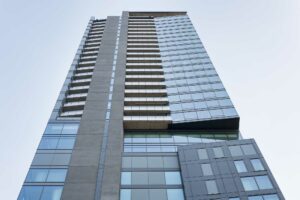
SAFETY FIRST
When it comes to glass façades, safety is non-negotiable. Canadian standards, in particular those set by the CSA Group, standardize how glass withstands impacts, wind, and environmental loads such as snow and ice. The building’s intended use (commercial, institutional, residential) will determine if tempered or laminated glass is required. These reduce the risk of injury in the event of breakage. Moreover, the Quebec Construction Code outlines requirements related to installation and structural performance.
ACOUSTIC COMFORT
Noise levels can be a major challenge in urban settings. That’s where glass façades come in. They need to contribute to the acoustic comfort of the building’s occupants. STC (Sound Transmission Class) is a rating that assesses how well a glass façade reduces noise. When combined with acoustic spacers, double or triple glazing allows buildings to meet requirements while enhancing the well-being of occupants.
ENERGY EFFICIENCY REMAINS A TOP PRIORITY

Quebec is renowned for its harsh winters and sweltering summers, making a building’s energy efficiency extremely important. Regulations are intended to optimize a building’s efficiency without compromising the comfort of its occupants or its sustainability. To this end, the industry relies on U-values and R-values, the Solar Heat Gain Coefficient (SHGC), and low-emissivity (Low-E) coatings. Glass façades must also comply with the National Energy Code of Canada for Buildings as well as provincial regulations.
CERTIFICATIONS
In addition to regulatory requirements, there are certain certifications that add significant value to projects. LEED certification is one example. It is issued to environmentally high-performing buildings. ENERGY STAR is another example. It attests to the energy efficiency of specific components. While these certifications are not mandatory, they represent a major asset for building owners and occupants.
In sum, complying with regulatory requirements and obtaining certifications means investing in the safety, comfort, and sustainability of buildings. At Epsylon, our expertise allows us to design visually pleasing, high-performance glass envelopes that comply with regulations currently in force.